PRELUDE TO
“BIG BEND MELEE”
This story was written by our Grandmother,
Mary Edith Wilder Hays
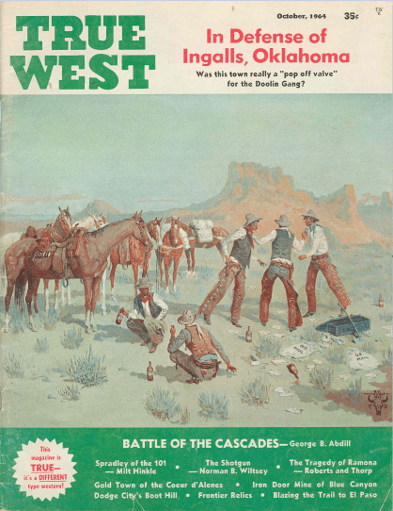
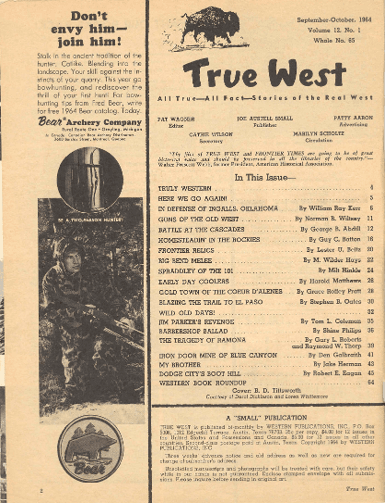
Her story is of a young boy’s account of an Indian and a ‘River Driver’ fight occurring in the early 1900’s. After writing it, many years later, she sent the manuscript to True West magazine, a Superior Publishing Company—they published it in their October issue of 1964. She received a check from them in the amount of $35.00, then a fair amount of money as a writer’s fee.
From the time that I first read her story as a teenager, I suspected that, while told by a boy, it was really her that had seen it first hand and was telling it, through the eyes of a third person.
When I asked her about my thoughts on it—she just smiled! Even then, I didn’t really know for sure… but, we never spoke of it again. If it was her secret—it remained with her!
Enjoy… Dan
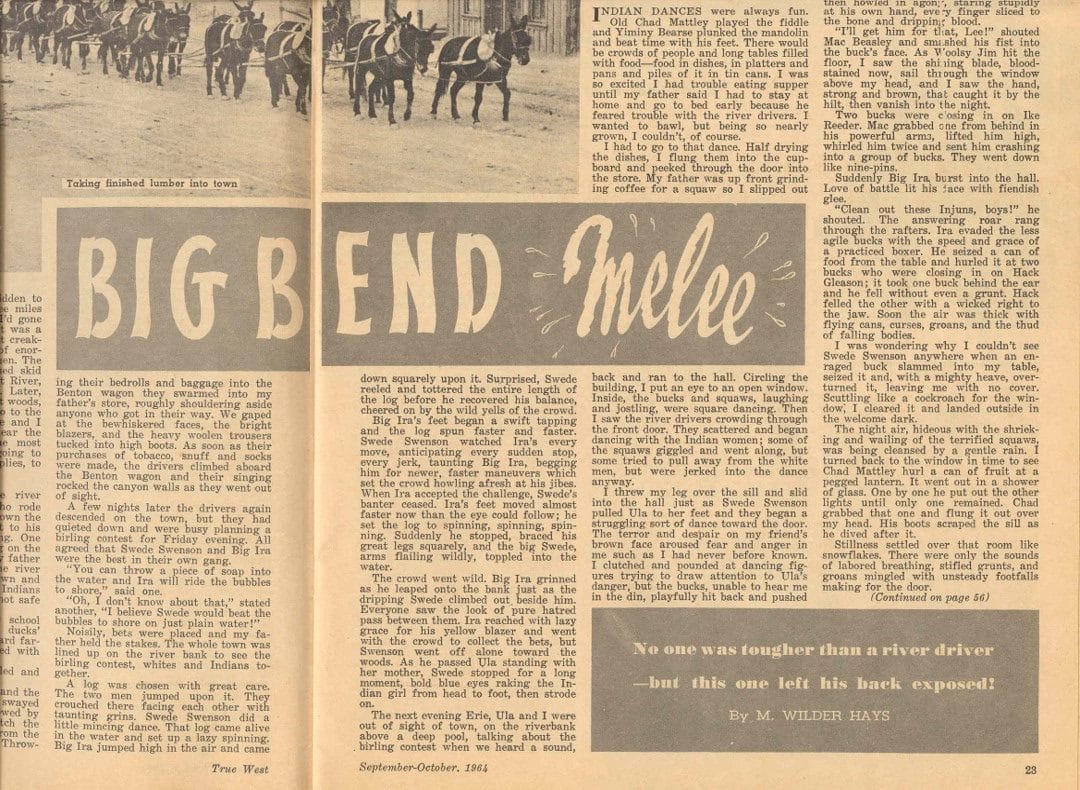
BIG BEND MELEE
My father insisted to the last day of his life that I did not see the big fight between the Pit River Indians and the river drivers—that I was safe at home in bed and that I am able to tell about it only because I’d heard him talk about it so often!
Not only did I see the fight from beginning to end, but I knew whose hand slid the knife between Swede Swenson’s ribs. The next day when I looked at Swede lying stiff and cold on a table in our little church… I didn’t say one word about what I knew.
Because there was rivalry and hatred between the two men, people secretly thought that Big Ira knifed the Swede, but the coroner’s jury ruled that he met his death by an unknown party—nothing more was ever done about it.
My father and I lived in three rooms in the back of his little store in Big Bend—my mother having died a couple of years back; and there we did our own cooking and housework. When these chores were finished I could do pretty well as I pleased.
My closest friends were Erie Gogan, an Indian boy, and his sister Ula. Erie was my age—twelve, and Ula was two years older. Beautiful and graceful as a young deer, Ula could run and swim as fast and as far as we boys could, so we graciously allowed her to go with us wherever we went.
When the low drumming of a grouse or the chattering echo of a coyote’s wail announced the arrival of my Indian chums, I’d sidle through the store filling my pockets with raisins, a wedge of cheese, cookies and apples. Then we’d meet to roam the woods or to swim in the river—there were no secrets in either that we did not know. One place, however, was forbidden to us—Ole man Benton’s logging camp, three miles away on a plateau above town. I’d gone there once with my father—it was a different world, a world of great creaking chains and straining oxen, of enormous logs and toiling and shouting men. The logs were snaked along a greased skid road to the cliff’s edge above Pit River—there to await the spring drive.
Later, walking home through the moonlit woods, my father warned me never to go to the camp without him and that Erie and I must never, never bring Ula near the loggers. These woodsmen, for the most part, kept clear of the Bend, going to Redding on pay days to buy supplies, to drink and to gamble.
With each spring came the river drivers—big, husky men who rode the logs from Benton’s Landing down the wicked, boiling silver waters of the Pit to his mill on Turtle Bay near Redding. One night in our store, as I lay dozing on the floor behind the stove, I heard my father and Mr. Blaine talking about the river drivers—how they overran the town and always caused trouble among the Indians because the Indian women were not safe from their molesting.
The very next evening after school, Erie, Ula and I were hunting ducks’ nests along the river when we heard far‑off sounds of lusty singing mixed with shouts of laughter. “The river drivers!” Erie yelled and we sprinted for the store.
We heard the galloping horses and the rumbling wagons as the stage swayed around a bend in the road, followed by a wagon sent by Benton to fetch the river drivers. Huge men leaped from the stage before it was fairly stopped. Throwing their bedrolls and baggage into the Benton wagon, they swarmed into my father’s store—roughly shouldering aside anyone who got in their way. We gaped at the bewhiskered faces, the bright blazers, and the heavy woolen trousers tucked into high boots. As soon as their purchases of tobacco, snuff and socks were made, the drivers climbed aboard the Benton wagon and their singing rocked the canyon walls as they went out of sight.
A few nights later, the drivers again descended on the town, but they had quieted down and were busy planning a birling contest for Friday evening. All agreed that Swede Swenson and Big Ira were the best in their own gang.
“You can throw a piece of soap into the water and Ira will ride the bubbles to shore,” said one.
“Oh I don’t know about that,” stated another, “I believe Swede would beat the bubbles to shore on just plain water!”
Noisily, bets were placed… and my father held the stakes. The whole town was lined up on the river bank to see the birling contest—whites and Indians together.
A log was chosen with great care. The two men jumped upon it. They crouched there… facing each other with taunting grins. Swede Swenson did a little mincing dance. That log came alive in the water and set up a lazy spinning. Big Ira jumped high in the air and came down squarely upon it. Surprised, Swede reeled and tottered the entire length of the log before he recovered his balance—cheered on by the wild yells of the crowd.
Big Ira’s feet began a swift tapping and the log spun faster and faster. Swede Swenson watched Ira’s every move…. anticipating every sudden stop, every jerk… taunting Big Ira, begging him for newer, faster maneuvers which set the crowd howling afresh at his jibes. When Ira accepted the challenge, Swede’s banter ceased. Ira’s feet moved almost faster now than the eye could follow; he set the log to spinning—spinning and spinning. Suddenly he stopped, braced his great legs squarely, and the big Swede, arms flailing wildly—toppled into the water.
The crowd went wild. Big Ira grinned as he leaped onto the bank, just as the dripping Swede climbed out beside him. Everyone saw the look of pure hatred pass between them. Ira reached, with lazy grace, for his yellow blazer and went with the crowd to collect the bets, but Swenson went off alone toward the woods. As he passed Ula, standing with her mother, Swede stopped for a long moment…. his bold blue eyes raking the Indian girl from head to foot—then strode on.
The next evening Erie, Ula and I were out of sight of town, on the riverbank above a deep pool. We were talking about the birling contest when we heard a sound—a rustle. Swede Swenson stepped from behind a bush. I get goose pimples even now when I remember the look on his face.
“You boys hit for home,” he said and made a grab for Ula.
In that split second of fear, Erie’s foot darted out and sent Swede sprawling headlong. Ula, in response to my up-flung arm, whirled and cut the air in a wide arc to the silver pool below—Erie and I hit the water together and were safely away. Fortunately, as it turned out, we told no one…no one at all about this incident. If we had, they might have guessed who slid the knife into Swede Swenson that very night.
Indian dances were always fun. Old Chad Mattley would play the fiddle while Yiminy Bearse plunked the mandolin and beat time with his feet. There would be crowds of people and long tables filled with food—food in dishes, in platters and pans and piles of it in tin cans. I was so excited I had trouble eating supper… and then my father said I had to stay at home and go to bed early—he feared trouble with the river drivers. I wanted to bawl, but being so nearly grown, I couldn’t of course.
I had to get to that dance. Half drying the dishes, I flung them into the cupboard and peeked through the door into the store. My father was up front grinding coffee for a squaw, so I slipped out back and ran to the hall. Circling the building, I put an eye to an open window. Inside, the bucks and squaws laughing and jostling, were square dancing. Then I saw the river drivers crowding through the front door. They scattered and began dancing with the Indian women. Some of the squaws giggled and went along, but some tried to pull away from the White men… but were jerked into the dance anyway.
I threw my leg over the sill and slid into the hall just as Swede Swenson pulled Ula to her feet and they began a struggling sort of dance toward the door. The terror and despair on my friend’s brown face aroused fear and anger in me such as I had never before known. I clutched and pounded at dancing figures, trying to draw attention to Ula’s danger, but the bucks, unable to hear me in the din, playfully hit back and pushed me aside. At the door, I almost fell down with relief when I saw Ula and her father come hurrying back into the hall. I was a man grown…. before I realized that the scalping generations had molded that look on her father’s face. Ula ran to her mother and I scooted under a table near my window.
The next quadrille was about to begin when trouble flared to bursting. The Indian men gathered, an angry buzzing swarm, while women and children faded from the hall.
“I can lick man as big as pine tree!” yelled Woolsy Jim. Murder skated along the wicked, shining blade of the butcher knife he snatched from the table. Lee Crandall grabbed for the buck’s wrist, then howled in agony, staring stupidly at his own hand, every finger sliced to the bone and dripping with blood.
“I’ll get him for that Lee”, shouted Mac Beasley and smashed his fist into the buck’s face. As Woolsy Jim hit the floor, I saw the shining blade, blood‑stained now, sail through the window above my head—and I saw the hand, strong and brown, that caught it by the hilt, then vanish into the night.
Two bucks were closing in on Ike Reeder. Mac grabbed one from behind in his powerful arms, lifted him high, whirled him twice and sent him crashing into a group of bucks. They went down like ninepins.
Suddenly Big Ira burst into the hall—love of battle lit his face with fiendish glee.
“Clean out these Injuns, boys!” he shouted. The answering roar rang through the rafters. Ira evaded the less agile bucks with the speed and grace of a practiced boxer. He seized a can of food from the table and hurled it at two bucks who were closing in on Hack Gleason—it took one buck behind the ear and he fell without even a grunt. Hack felled the other with a wicked right to the jaw. Soon the air was thick with flying cans, curses, groans, and the thud of falling bodies.
I was wondering why I couldn’t see Swede Swenson anywhere, when an enraged buck slammed into my table, seized it and, with a mighty heave, overturned it—leaving me with no cover.
Scuttling like a cockroach for the window, I cleared it and landed outside in the welcome dark.
The night air, hideous with the shrieking and wailing of the terrified squaws—was being cleansed by a gentle rain.
I turned back to the window in time to see Chad Mattley hurl a can of fruit at a pegged lantern—it went out in a shower of glass. One by one he put out the other lights until only one remained. Chad grabbed that one and flung it out over my head—his boots scraped the sill as he dived after it.
Stillness settled over that room like snowflakes. There were only the sounds of labored breathing, stifled grunts, and groans mingled with unsteady footfalls making for the door.
Stealthily I sought the woods trail home, wishing Erie had been with me this night. Erie…! Where had he been all this time? Later I learned that the Indian boy had been locked in his room by his father to keep him out of trouble—and that Ula and her mother had been warned not to go to the dance, but they had gone anyway. I decided now… that I’d detour by Erie’s house and see him if I could.
The Gogan house was in deep woods and I was sheltered as I halted. I saw lamplight shining on Erie and his mother seated in the main room. She was, I thought, telling her son about the happenings at the hall and then movement at Ula’s bedroom window caught my eye. Her light shone through a mere slit at the bottom of the shade—but enough to show Swede Swenson stooping to peer through that slit. I sucked in my breath in an agony of indecision. I wanted to run for help—I meant to go… but my feet just stayed there… frozen to the pine needles, until my problem was solved by a shadowy figure detaching itself from the dark forest and seeming almost to float across the space between it and the Swede. A slight sound from this figure turned the big river driver just right to take the razor‑sharp butcher knife between his ribs. Swede didn’t even gurgle. He just folded quietly, silently, and lay perfectly still with the rain misting his beard.
I knew that I was going to be very, very sick, but I didn’t leave until I saw Ula’s father drag the dead man away from his daughter’s window in the direction of the hall.
.

Circa 1916